
Get a Free Trial for 24 Hours
Don’t wait, don’t hesitate. Claim your free IPTV trial right now and see the difference for yourself before you commit to anything.
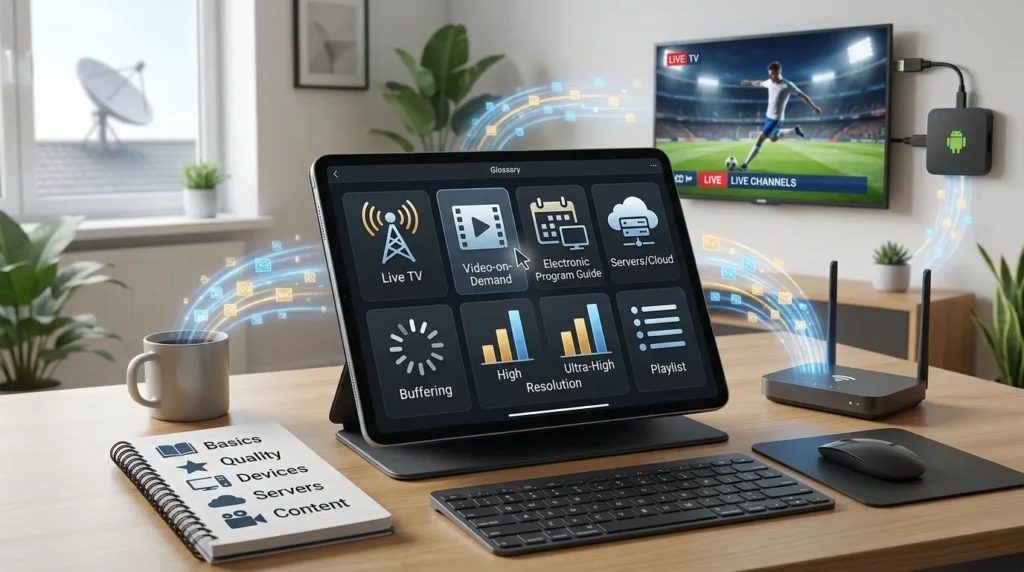
Get My Free Trial →IPTV comes with its own language, and that language can feel overwhelming the first time you research a service, set up an app, or read through a subscription page. This guide brings every common IPTV term into one place and explains each one in plain, practical language. Whether you are wondering what IPTV means for the first time or trying to understand a specific word you keep running into, this glossary is organized so you can jump straight to the section you need or read through the full guide to build a complete understanding of how IPTV works from start to finish.
IPTV Basics and Core Terms
Before diving into technical details, it helps to understand what IPTV actually means and how it fits into the broader world of television.
What Does IPTV Mean?
IPTV stands for Internet Protocol Television. It describes any television service that delivers content over an internet connection instead of through traditional broadcast, cable, or satellite signals. Instead of a fixed signal reaching every household at once, an IPTV service sends a data stream directly to your device when you request it, which is why the experience often feels more flexible and on-demand than older TV delivery methods. For a deeper walkthrough of the concept, see our full guide on what IPTV is.
IPTV Explained for Beginners
At its simplest, IPTV works by breaking video content into small packets of data and sending them across the internet to your streaming device, where they are reassembled and played back in real time. This is fundamentally different from cable, which pushes a constant broadcast signal through a physical wire, or satellite, which beams a signal from space. Because IPTV relies on your internet connection rather than dedicated broadcast infrastructure, it can typically be set up in minutes on almost any connected device. Our guide on how IPTV actually works breaks the process down step by step.
IPTV Terminology Overview
As you explore IPTV services, you will encounter recurring terms related to content type (live TV vs VOD), the software you use to watch (IPTV player or app), the technology behind the scenes (servers, protocols, playlists), and the business side of things (subscriptions, connections, terms of service). Understanding these categories makes the rest of this glossary much easier to follow.
IPTV Glossary Purpose
Think of this article as a reference you can return to. Instead of searching for each unfamiliar word separately, bookmark this guide and use it whenever a new term appears while browsing, setting up, or troubleshooting your IPTV service.
Get a Free Trial for 24 Hours
Don’t wait, don’t hesitate. Claim your free IPTV trial right now and see the difference for yourself before you commit to anything.
Get My Free Trial →Streaming Quality and Technical Terms
Streaming quality terms describe how video is delivered and how good it looks and performs on your screen.
What Does Bitrate Mean in IPTV?
Bitrate refers to how much data is transmitted per second to build the video and audio you see and hear. A higher bitrate generally means more picture detail, but it also demands more from your internet connection. If your connection or device cannot keep up with a high bitrate stream, the result is buffering or dropped frames rather than a better picture, which is why bitrate needs to be matched to your actual internet speed.
IPTV Resolution Explained: 720p, 1080p, and 4K
Resolution describes how many pixels make up the picture, with more pixels generally producing a sharper image. 720p and 1080p fall under standard and Full HD, while 4K, also called Ultra HD, contains significantly more pixel detail. A higher resolution only improves your experience if your screen, device, and internet connection can all support it consistently.
What Is Buffering in IPTV?
Buffering happens when your player pauses playback because it does not yet have enough data downloaded to continue smoothly. It is usually caused by insufficient internet speed, Wi-Fi interference, network congestion, or an overloaded device rather than a flaw in the content itself. Our detailed guide on fixing IPTV buffering and freezing walks through the most common causes and fixes in depth.
What Is Adaptive Bitrate Streaming?
Adaptive bitrate streaming allows a service to automatically adjust video quality in real time based on your current network conditions. Instead of stopping completely when your connection slows down, the stream can drop to a lower resolution temporarily to keep playback smooth, then return to higher quality once your connection improves.
HD, FHD, UHD, and 4K Explained
These labels describe increasing tiers of picture detail: HD generally refers to 720p, FHD (Full HD) refers to 1080p, and UHD or 4K refers to significantly higher resolution content. The best tier for you depends on your screen size, viewing distance, and whether your internet connection and device can reliably support the higher data demands of each step up.
Get a Free Trial for 24 Hours
Don’t wait, don’t hesitate. Claim your free IPTV trial right now and see the difference for yourself before you commit to anything.
Get My Free Trial →IPTV Devices and Apps
This section covers the software and hardware terminology you will encounter when actually watching IPTV.
What Is an IPTV Player?
An IPTV player is the application that receives and displays your IPTV content. It handles playlists, channel organization, program guide data, and playback controls. It is important to understand that the player is generally separate from your subscription itself, meaning the app you install is different from the service providing your channels and content.
IPTV App vs IPTV Player: What Is the Difference?
These terms are often used interchangeably, but there is a subtle distinction. An “app” typically refers to the installed application on your device, while “player” often refers to the software engine handling playback within that app. In everyday use, most people treat the two terms as meaning the same thing: the software you open to watch your IPTV content.
IPTV App Compatibility Explained
Compatibility refers to whether a given app works properly on your specific device, operating system, and hardware. Not every app supports every device, and features like program guides, subtitles, or multiple simultaneous connections can vary between platforms. Checking compatibility before setup helps avoid frustration later.
IPTV Smart TV Terms
Setting up IPTV on a smart TV often involves the same core terminology as other devices: player, playlist, login credentials, EPG, and VOD. The main difference is that smart TV operating systems can vary in which apps are available and how they are installed, so it is worth confirming your specific TV brand supports the app you plan to use.
IPTV Device Requirements
Device requirements refer to the hardware and software a device needs to run IPTV smoothly, including processing power, available storage, network connectivity, and operating system compatibility. Devices with modern processors and stable internet connections generally handle higher resolution streams with fewer issues than older or underpowered hardware.
Get a Free Trial for 24 Hours
Don’t wait, don’t hesitate. Claim your free IPTV trial right now and see the difference for yourself before you commit to anything.
Get My Free Trial →IPTV Servers and Network Terms
Behind every IPTV stream is server infrastructure that manages and delivers content. These terms explain how that works.
What Is an IPTV Server?
An IPTV server is the infrastructure responsible for storing, organizing, and distributing content to viewers over the internet. When you press play, your device communicates with a server that sends back the requested stream. Server performance directly affects how consistent and reliable your viewing experience is.
What Is IPTV Server Uptime?
Uptime describes the percentage of time a server or service is available and functioning normally. A high uptime percentage suggests reliability, but it does not guarantee a perfect experience every time, since factors like your own internet connection also affect what you actually see on screen.
What Is IPTV Server Load?
Server load refers to how much demand a server is currently handling. When many viewers are streaming at once, especially during peak hours, higher load can occasionally affect stream stability if the underlying infrastructure is not built to scale with demand.
IPTV Server Location Explained
Server location refers to where the physical infrastructure delivering your stream is based. While distance can influence latency in some cases, routing quality and network capacity often matter more than raw geographic distance, so the closest server is not automatically the fastest option.
IPTV Latency vs Buffering
Latency refers to the delay between when something happens live and when it appears on your screen, while buffering refers to playback pausing because not enough data has arrived yet. They are related to network performance but describe different symptoms, and understanding which one you are experiencing helps you troubleshoot more effectively.
Get a Free Trial for 24 Hours
Don’t wait, don’t hesitate. Claim your free IPTV trial right now and see the difference for yourself before you commit to anything.
Get My Free Trial →IPTV Content and Channel Terms
These terms describe how content is organized and delivered once you are actually browsing your service.
What Is IPTV VOD?
VOD stands for video on demand, referring to a library of movies, shows, or other content you can choose and watch whenever you want, rather than following a fixed broadcast schedule. VOD libraries are a major part of most modern IPTV services alongside live channels.
What Is IPTV Live TV?
Live TV refers to channels streamed in real time, following a set schedule the same way traditional broadcast television does. Unlike VOD, live TV content plays on its own timeline rather than being available whenever you choose to start it.
IPTV EPG Meaning Explained
EPG stands for electronic program guide. It displays program names, schedules, and descriptions for live channels, making it easier to browse what is currently airing or coming up next, similar to a traditional TV guide.
IPTV Catch Up TV Meaning
Catch up TV allows viewers to watch certain programs after their original live broadcast has ended, typically for a limited replay window. It sits between live TV and full VOD, giving flexibility for programs you may have missed without offering the entire library on demand.
IPTV Channel List Terms
Channel lists often include more than just names. Categories, groups, regions, and channel logos help organize large lineups into browsable sections, such as sports, news, entertainment, or international content, making it easier to find what you want to watch.
Get a Free Trial for 24 Hours
Don’t wait, don’t hesitate. Claim your free IPTV trial right now and see the difference for yourself before you commit to anything.
Get My Free Trial →IPTV Subscription and Pricing Terms
Understanding subscription terminology helps you compare plans accurately and avoid confusion after signing up.
IPTV Subscription Meaning Explained
A subscription gives you access to a package of IPTV content for a defined period, under specific terms set by the provider. What is included, such as channel count, VOD access, and device support, can vary meaningfully between plans, so it is worth reviewing the details rather than assuming all subscriptions are the same.
What Does IPTV Multiple Connections Mean?
Multiple connections refer to how many simultaneous streams a single subscription supports at once. This is different from how many devices have the app installed. A plan with multiple connections allows more than one household member to stream different content at the same time without interruption.
IPTV Trial vs Subscription Explained
A trial gives you short-term access to test a service before committing to a paid plan, while a full subscription provides ongoing access under agreed terms. Trials are useful for checking channel stability, picture quality, device compatibility, and support responsiveness before paying. You can start your free 24-hour IPTV trial to test everything firsthand before subscribing.
IPTV Subscription Terms and Conditions
Subscription terms typically cover billing periods, renewal policies, device limits, refund conditions, and account usage rules. Reviewing these details before purchasing helps you understand exactly what you are agreeing to and avoid unexpected surprises later.
IPTV Monthly vs Yearly Plan Meaning
Monthly plans offer short-term flexibility, while yearly plans often provide a lower cost per month in exchange for a longer upfront commitment. The right choice depends on how confident you are in the service and whether you have already tested it through a trial period.
Get a Free Trial for 24 Hours
Don’t wait, don’t hesitate. Claim your free IPTV trial right now and see the difference for yourself before you commit to anything.
Get My Free Trial →IPTV Legality, Privacy, and Security Terms
These terms help you understand the legal and safety side of using IPTV responsibly.
What Does IPTV Legal Mean?
IPTV itself is a delivery technology, not a specific type of content, so it is legal in the same way that streaming or broadcasting technology in general is legal. What determines legality is whether the content being delivered is properly licensed and distributed with appropriate rights. For a full explanation, read our guide on is IPTV legal.
IPTV Copyright Terms Explained
Copyright terminology relates to who owns the rights to distribute specific television programs and movies. Understanding that content ownership and licensing exist behind every legitimate broadcast helps explain why transparency and proper distribution matter when evaluating any streaming service.
IPTV VPN Meaning Explained
A VPN changes how your internet traffic is routed and encrypted, which can affect privacy and, in some cases, connection speed. Using a VPN does not change the legal status of any content, and it is a personal choice related to privacy and network routing rather than a requirement for using IPTV.
IPTV Privacy Terms Explained
Privacy-related terms cover how your account information, device details, and activity data are handled by an app or service. Reviewing privacy practices before installing an app or subscribing to a service is a reasonable step for any internet-connected product, including IPTV.
IPTV Security Terms for Beginners
Basic IPTV security involves practices like using strong, unique passwords, avoiding untrusted third-party applications, and keeping your apps and devices updated. These habits reduce risk in the same way they do for any other online account or connected device.
Get a Free Trial for 24 Hours
Don’t wait, don’t hesitate. Claim your free IPTV trial right now and see the difference for yourself before you commit to anything.
Get My Free Trial →IPTV Troubleshooting and Performance Terms
When something goes wrong, these terms help you understand what the error actually means.
What Is an IPTV Timeout Error?
A timeout error means your player was unable to establish or maintain a connection within the expected time frame. This can point to an internet connectivity issue, a server availability problem, or an application setting, and identifying which one is affected helps target the right fix.
IPTV Portal URL Meaning Explained
A portal URL is an address some IPTV setups use to connect an application to a service. If a portal address is entered incorrectly, the app will typically fail to connect, so double-checking the exact address is usually the first troubleshooting step.
IPTV Login Credentials Explained
Login credentials are the details, such as a username and password, used to authenticate your access to a service. Entering these details incorrectly is one of the most common reasons an app fails to connect on first setup.
IPTV Connection Error Meaning
A connection error can point to several different underlying issues, including an unavailable server, rejected credentials, or an unstable internet connection. Identifying which category the error falls into makes troubleshooting far more efficient than simply restarting the app repeatedly.
IPTV Playback Error Terms Explained
Playback errors occur after a connection is successfully established but the video itself fails to display or play correctly. These can relate to unsupported formats, interrupted streams, or device limitations, and they are generally distinct from connection failures, which happen before playback even begins.
Get a Free Trial for 24 Hours
Don’t wait, don’t hesitate. Claim your free IPTV trial right now and see the difference for yourself before you commit to anything.
Get My Free Trial →IPTV Playlist and Format Terms
These more technical terms relate to how channel and content data is structured and delivered.
What Is an M3U Playlist in IPTV?
M3U is a common playlist format that organizes channel names, stream links, and related information so a compatible player can display and play them. An M3U file or link on its own is simply structured data; it is the player that interprets it and turns it into a usable channel list.
M3U vs M3U8 in IPTV Explained
M3U and M3U8 are closely related playlist formats, with the primary difference relating to text encoding. Most modern IPTV players support both formats, and the practical difference for everyday viewers is minimal.
IPTV Playlist URL Meaning
A playlist URL is a web address a compatible player uses to retrieve playlist data and stream information. Because it can be tied to account access, playlist URLs should be handled carefully, similar to login credentials.
IPTV XMLTV EPG Meaning
XMLTV is a data format commonly used to supply electronic program guide information. It allows compatible players to display accurate program names, schedules, and descriptions alongside your live channel list.
IPTV Stream URL Types Explained
Stream URLs can take different forms depending on the service and protocol involved, ranging from direct media links to playlist or portal-based addresses. Understanding what type of URL you have received helps clarify how it should be entered into your player.
Get a Free Trial for 24 Hours
Don’t wait, don’t hesitate. Claim your free IPTV trial right now and see the difference for yourself before you commit to anything.
Get My Free Trial →Advanced IPTV Protocol and Technology Terms
For readers who want to understand the technology at a deeper level, these terms describe how streams are actually built and delivered.
What Is HLS in IPTV?
HLS, or HTTP Live Streaming, is a widely used method for delivering video by splitting it into small segments that a player downloads and plays in sequence. It works well over standard internet connections and often pairs with adaptive bitrate streaming to adjust quality based on network conditions.
What Is MPEG-TS in IPTV?
MPEG-TS is a transport stream format used to carry audio and video data together, commonly associated with live television delivery. Different players support this format to varying degrees, which is one reason certain streams may perform differently across devices.
IPTV Multicast vs Unicast Explained
Unicast delivers a stream individually to each requesting device, while multicast can distribute a single stream to multiple recipients at once within networks that support it. Most home internet IPTV setups rely on unicast delivery, while multicast is more common in managed network environments.
IPTV Codec Terms Explained: H264, H265, and HEVC
A codec determines how video is compressed and decoded. H264 is a widely supported, well-established codec, while H265, also known as HEVC, offers more efficient compression at similar quality, though it requires compatible hardware to decode properly. Device support for each codec varies, which can affect playback compatibility.
IPTV Transcoding Meaning Explained
Transcoding is the process of converting video from one format, resolution, or bitrate into another, often to improve compatibility with a specific device or network condition. It requires processing resources and can affect both performance and quality depending on how it is implemented.
Get a Free Trial for 24 Hours
Don’t wait, don’t hesitate. Claim your free IPTV trial right now and see the difference for yourself before you commit to anything.
Get My Free Trial →Bringing It All Together
Learning IPTV terminology does not require a technical background. Most of these terms exist to describe practical parts of the experience: how content reaches your screen, how you interact with it, and what your subscription actually includes. The more familiar you become with these words, the easier it becomes to compare services, troubleshoot problems, and set up your streaming experience with confidence. For a broader foundation, revisit our guides on what IPTV is and how IPTV works, and if you run into playback issues, our buffering and freezing guide is a practical next step.
Frequently Asked Questions
What does IPTV mean in simple terms?
IPTV stands for Internet Protocol Television, meaning television content delivered over an internet connection instead of traditional broadcast, cable, or satellite signals.
What is the difference between IPTV live TV and VOD?
Live TV follows a fixed broadcast schedule in real time, while VOD, or video on demand, lets you choose and watch content whenever you want.
What does EPG mean in IPTV?
EPG stands for electronic program guide, a feature that displays schedules and program information for live channels, similar to a traditional TV guide.
Is a VPN required to use IPTV?
No. A VPN is a personal choice related to privacy and connection routing, not a requirement for using an IPTV service.
What is the easiest way to understand all these IPTV terms?
Bookmark this glossary and refer back to it whenever you encounter an unfamiliar word while researching, setting up, or troubleshooting your IPTV service.
Get a Free Trial for 24 Hours
Don’t wait, don’t hesitate. Claim your free IPTV trial right now and see the difference for yourself before you commit to anything.
Get My Free Trial →See How IPTV Works for Yourself
The best way to understand IPTV is to experience it directly. Open your free 24-hour IPTV trial today and explore live channels, VOD content, and everything covered in this glossary firsthand.