
Save 20%+ On Every IPTV Plan
Class is back in session and so are the savings. Grab your plan before this back to school deal packs up and heads home.
Disclaimer: This article is written for general informational purposes only and does not constitute legal advice. Laws and enforcement practices can change, and individual circumstances vary. If you have specific legal concerns, consult a qualified attorney.
IPTV has become one of the most searched terms in American streaming, and one question comes up more than any other: is IPTV legal in the USA? The honest answer is more nuanced than a simple yes or no. IPTV itself is a delivery technology, not a type of content, and whether a specific IPTV service is legal depends entirely on how that service obtains and distributes its programming. This guide breaks down everything a US-based viewer needs to understand in 2026, from copyright basics to free and paid services, sports streaming, apps and devices, and exactly how to identify a provider that is doing things the right way.
What Is IPTV and How Does It Work in the USA?
Before addressing legality directly, it helps to understand what IPTV actually is. IPTV, short for Internet Protocol Television, delivers television channels and on-demand content over an internet connection instead of through a cable wire or satellite dish. Instead of a broadcast signal reaching every household at once, an IPTV service streams data directly to your device when you request it. For a full breakdown of the mechanics, see our guides on what IPTV is and how IPTV actually works.
This distinction matters because it sets up the entire legal conversation. The technology behind IPTV is neutral. What makes a service lawful or unlawful is not the internet connection or the app, it is whether the underlying content is properly licensed.
Is IPTV Legal in the USA? The Straight Answer
Yes, IPTV as a technology is completely legal in the United States. Millions of Americans use IPTV every day through fully licensed platforms without ever running into a legal issue. The confusion comes from the fact that “IPTV” is also used loosely to describe unauthorized services that stream copyrighted channels without permission.
IPTV Technology vs IPTV Content
Think of IPTV the same way you would think of a delivery truck. The truck itself is not illegal. What matters is what is being delivered and whether the sender had the right to send it. An IPTV app or player is simply the delivery mechanism. The legal question always comes back to the content flowing through it and whether that content was authorized for distribution.
Why the Provider Determines Legality
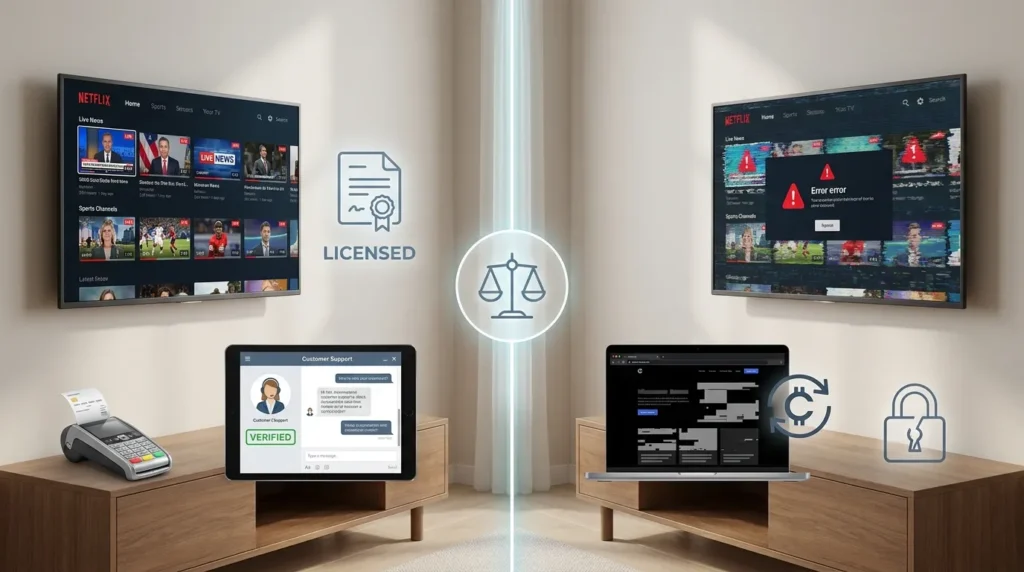
Two IPTV services can use nearly identical technology and still sit on opposite sides of the law. One provider pays licensing fees, secures distribution rights, and operates as a transparent, registered business. Another provider captures broadcast signals without permission and resells them. The technology looks the same from the outside. The legal status is completely different underneath.
The Federal Law That Applies
In the United States, IPTV legality falls under federal copyright law, primarily the Digital Millennium Copyright Act (DMCA). This law makes it unlawful to distribute copyrighted content without proper authorization, and by extension, using a service that knowingly streams unlicensed copyrighted programming can expose a subscriber to legal risk. Using a properly licensed IPTV or streaming service, on the other hand, carries no such exposure, because the provider has already secured the rights to deliver that content.
Save 20%+ On Every IPTV Plan
Class is back in session and so are the savings. Grab your plan before this back to school deal packs up and heads home.
What Makes an IPTV Service Legal in the USA?
A legitimate IPTV provider does specific groundwork that unauthorized services skip entirely.
Proper Licensing and Broadcasting Rights
Legal IPTV services negotiate and pay for the rights to carry each channel or piece of content they offer. This is true whether the service is a traditional cable alternative like YouTube TV, Hulu Live TV, Sling TV, FuboTV, or DirecTV Stream, or a dedicated IPTV provider. Licensing fees are a major part of these companies’ operating costs, which is directly reflected in their subscription pricing.
Business Transparency and Registered Operations
A real, legitimate IPTV company has a traceable business identity: a registered name, a real address, published legal pages, and accountable ownership. This transparency is not a formality. It is one of the clearest signals that a company has something legitimate to stand behind.
Compliance With Content Distribution Laws
Beyond licensing, a legal provider follows regional distribution rules, meaning they only offer content in markets where they hold the rights to do so. This is why some channels are only available through certain providers in certain countries, a direct result of how broadcasting rights are negotiated on a market-by-market basis.
IPTV Copyright and Licensing Laws in the USA Explained
Copyright is the legal foundation that determines whether IPTV content is being distributed lawfully.
How Copyright Protects Broadcast Content
Television programming, live sports, movies, and news broadcasts are protected under US copyright law the moment they are created. The rights holder, whether a network, studio, or sports league, controls who is authorized to redistribute that content and under what terms.
Why Technology Alone Doesn’t Make a Service Legal
Having a functional app, a slick website, or a large channel list does not automatically mean a provider has been granted distribution rights. Many unauthorized IPTV services look polished on the surface while operating without any licensing agreements behind the scenes. This is precisely why the technology and the legality of a service need to be evaluated separately.
What Happens When Content Is Distributed Without Rights
When a provider streams copyrighted programming without authorization, every stream it delivers constitutes a separate act of infringement under US copyright law. This is treated seriously by rights holders, who increasingly invest in tracking and shutting down unauthorized operations.
Save 20%+ On Every IPTV Plan
Class is back in session and so are the savings. Grab your plan before this back to school deal packs up and heads home.
Are Free IPTV Services Legal in the USA?
Free access does not automatically mean a service is operating outside the law, but it also does not guarantee legality. The distinction comes down entirely to where the content originates.
Legitimate Free, Ad-Supported IPTV Platforms
There are genuinely free, fully licensed IPTV and streaming platforms operating in the USA that generate revenue through advertising instead of subscriptions. Services such as Pluto TV, Tubi, Peacock’s free tier, and Plex TV are examples of platforms that have secured proper licensing while remaining free to the viewer. Using these services carries no legal risk because the underlying content has been authorized for distribution.
Why “Free” From Unofficial Sources Is Different
Free IPTV apps distributed through unofficial websites, sideloaded APK files, or unverified third-party addons are a different category entirely. These services are often free precisely because they are not paying for licensing at all, distributing copyrighted content without permission and without any revenue obligation to the rights holders.
How to Tell Legal Free IPTV From Unauthorized Free IPTV
The clearest signal is distribution channel and business transparency. Legitimate free IPTV platforms are available through official app stores, clearly display their company information, and operate ad-supported business models that are publicly understood. Unauthorized free IPTV sources typically require sideloading, avoid identifying company information, and offer content combinations that would be extremely expensive to license legitimately.
Save 20%+ On Every IPTV Plan
Class is back in session and so are the savings. Grab your plan before this back to school deal packs up and heads home.
Is Paid IPTV Legal in the USA? Check Before You Subscribe
Paying for a subscription does not automatically confirm that a service is operating legally. Legality depends on what is behind the paywall, not the existence of a paywall itself.
Why Paying Doesn’t Guarantee Legality
A professional-looking checkout page, a monthly subscription fee, and a working app can all exist around a service that is still distributing unlicensed content. The presence of payment processing says nothing about whether the underlying programming was properly licensed.
Red Flags in Paid IPTV Subscriptions
- Pricing that seems impossibly low for the number of channels offered
- No identifiable company name, address, or legal pages
- Payment accepted only through cryptocurrency or wire transfer
- No presence on official app stores, requiring a sideloaded APK instead
- Customer support available only through unofficial messaging apps
What a Legitimate Paid Provider Looks Like
A legitimate paid IPTV service is upfront about its terms, offers standard payment methods like credit cards, provides real customer support, and publishes clear terms of service, a privacy policy, and a refund policy. These are not just legal formalities. They are practical signals that a business has structured itself to operate transparently.
Can IPTV Users Get in Trouble in the USA?
This is the question that worries most everyday viewers, and the honest answer requires some nuance.
Civil Risk for Individual Subscribers
Under US copyright law, knowingly using a service that streams unauthorized copyrighted content can technically expose a subscriber to civil liability, since receiving unauthorized content is treated as a form of infringement. In practice, enforcement has historically focused far more heavily on the providers and resellers operating illegal services rather than individual subscribers, though this focus has been gradually shifting as enforcement tools improve.
What Internet Service Providers Can Do
US internet service providers have taken an increasingly active role in this space. Depending on the provider and the circumstances, an ISP may send a warning notice when suspicious streaming activity is detected, throttle a connection, or in repeat cases, take stronger account-level action. This is generally the most realistic consequence an average subscriber might encounter, rather than direct legal prosecution.
Realistic Risk Level for Everyday Viewers
For the average person using an unauthorized IPTV service, the most likely outcome of enforcement activity is an ISP warning rather than a lawsuit. That said, “unlikely” is not the same as “impossible,” and the safest, most straightforward way to avoid any of this uncertainty is to use a properly licensed service from the start.
Is IPTV Sports Streaming Legal in the USA?
Sports content deserves its own section because it is one of the most heavily protected and most commonly misused categories in the IPTV space.
Why Sports Broadcasting Rights Are Especially Protected
Live sports broadcasting rights are extraordinarily valuable and tightly controlled. Leagues and broadcasters negotiate exclusive regional distribution agreements, meaning a specific game may only be legally available through one or two authorized outlets in a given market at any given time.
How to Evaluate an IPTV Sports Package
If an IPTV provider claims to offer every major sports package, every regional blackout-free game, and every premium pay-per-view event for a flat low monthly fee, that combination should raise questions. Authorized sports distribution rights are expensive, and a price that does not reflect that reality is a meaningful warning sign.
Legal Ways to Watch Live Sports via IPTV
The safest path is choosing an IPTV or streaming provider that is transparent about which sports rights it holds in your region, rather than one that vaguely promises “every game” without explanation. When in doubt, checking whether a provider is transparent about its sports content sourcing is one of the fastest ways to evaluate legitimacy.
Are IPTV Apps and Boxes Legal in the USA?
A common misconception is that the app or the streaming device itself determines legality. It does not.
The App or Device Is Not the Same as the Content Source
An IPTV player, whether it is a dedicated app or a general-purpose media player, is simply software that displays whatever content is fed into it. The device or application is not what makes a service lawful or unlawful. The content source is.
Firestick, Android Boxes, and Smart TVs
Devices like Fire TV Stick, Android boxes, and smart TVs are completely legal to own and use. Installing IPTV apps on them is also legal. Our comparison of Firestick vs Android Box for IPTV covers how each device performs, independent of any legal considerations, since the device itself carries no legal risk on its own.
What Determines Legality on Any Device
Whether you are watching on a Firestick, a smart TV, a phone, or a computer, the legal question is always the same: does the service supplying the stream have the rights to distribute that content? The device is simply the screen. The provider is where legality is actually determined.
Save 20%+ On Every IPTV Plan
Class is back in session and so are the savings. Grab your plan before this back to school deal packs up and heads home.
How to Tell If an IPTV Service Is Legal in the USA
Use this practical checklist before subscribing to any IPTV service.
Signs a service is likely legitimate:
- The company is real, searchable, and has a public business identity
- The app is available through official app stores
- Standard payment methods like credit cards are accepted
- Clear terms of service, privacy policy, and refund policy are published
- Customer support is reachable through official channels, such as a contact page
- Pricing aligns realistically with the volume and quality of content offered
- A free trial is offered so you can evaluate the service before paying
Signs a service may not be legitimate:
- Pricing that seems too low for the channel count being advertised
- No identifiable business name, address, or legal documentation
- Payment accepted only through crypto or wire transfer
- No presence on official app stores, requiring APK sideloading
- Support only available through informal messaging channels
Running through this list takes only a few minutes and can save you from subscribing to a service that puts you at unnecessary risk.
Legal IPTV vs Streaming Services: Which Is Right for You?
Once you understand what makes an IPTV service legitimate, the next question is how licensed IPTV compares to traditional cable-replacement streaming services. Both categories can be fully legal; the difference comes down to structure, pricing, and flexibility.
| Feature | Licensed IPTV Providers | Traditional Streaming Services (e.g. YouTube TV, Hulu Live TV, Sling TV, FuboTV, DirecTV Stream) |
| Channel variety | Often broader international and niche channel selection | Typically strong US network and cable channel coverage |
| Pricing structure | Frequently more affordable, flexible subscription lengths | Usually higher monthly pricing due to bundled cable-style packages |
| Device support | Wide range of apps across smart TVs, boxes, phones, tablets | Generally strong app support across major platforms |
| International content | Often included as standard | Usually limited or unavailable |
| Contract flexibility | Commonly offers monthly, quarterly, and annual options | Mostly month-to-month, with fewer long-term discount tiers |
| Free trial availability | Common among legitimate providers | Sometimes offered for limited promotional periods |
Both paths are completely legal when the provider is properly licensed. The right choice depends on whether you value broader international and specialty channel access at a lower price point, or a more mainstream, cable-style channel bundle. For a deeper comparison of IPTV against a specific legacy option, see our guide on IPTV vs traditional cable TV.
IPTV Laws in the USA: Latest Legal Rules and Regulations (2026)
The legal landscape around IPTV continues to evolve as enforcement tools and industry cooperation improve.
Federal Copyright Enforcement Trends
US copyright enforcement against unauthorized IPTV operations has intensified in recent years, with coordinated efforts between content owners, industry alliances, and law enforcement targeting large-scale illegal distribution operations. Enforcement has consistently prioritized providers and resellers over individual subscribers, but the overall trend has been toward more active monitoring across the space.
What Matters Heading Into 2026
As enforcement becomes more sophisticated, the core principle stays the same: legal status depends on licensing, not on the app, the device, or the price point. What has changed is that unauthorized services face a shrinking window before detection and shutdown, making service reliability itself a growing risk for anyone using unlicensed platforms.
What to Watch For Going Forward
Viewers should expect continued emphasis on provider transparency, official app store distribution, and standard payment processing as baseline expectations for legitimate services. Providers that cannot meet these basic transparency standards are increasingly likely to face disruption, which affects not just legal exposure but also the day-to-day reliability of the service itself.
Save 20%+ On Every IPTV Plan
Class is back in session and so are the savings. Grab your plan before this back to school deal packs up and heads home.
How to Choose a Legal IPTV Provider in the USA
Bringing everything together, choosing a legal IPTV provider comes down to verifying a few consistent signals: transparent business identity, realistic pricing, official app availability, standard payment processing, and clear legal documentation. Nova Prime IPTV publishes its terms of service, privacy policy, and refund policy, and offers a 24-hour free trial so you can evaluate the service firsthand before committing to a monthly, 3-month, 6-month, or annual plan. You can review the full pricing and features before making a decision, and if you have questions, the contact page connects you directly with support.
If you are researching options specifically for US viewers, our guide on the best IPTV services in the US and our broader why Nova Prime is the best IPTV service provider breakdown both go deeper into what to expect from a legitimate provider.
Frequently Asked Questions
Is IPTV legal in the USA?
IPTV as a technology is completely legal in the USA. Legality depends on whether the specific service you use has properly licensed the content it distributes, not on the technology itself.
Are free IPTV services legal in the USA?
Some are. Ad-supported platforms like Pluto TV, Tubi, Peacock’s free tier, and Plex TV are fully licensed and legal. Free IPTV apps distributed through unofficial sources without licensing are a different matter and carry legal risk.
Is paid IPTV automatically legal?
No. Paying a subscription fee does not confirm that a provider has proper licensing. Legality depends on whether the content itself was authorized for distribution, regardless of price.
Can I get in trouble for using IPTV in the USA?
Enforcement has historically focused on providers and resellers rather than individual subscribers. That said, using an unlicensed service does carry some legal exposure under US copyright law, and ISP warnings are the most realistic everyday consequence.
Is IPTV sports streaming legal?
It depends entirely on whether the provider holds proper distribution rights for the specific sports content being offered. Extremely low prices for extensive live sports coverage are a common warning sign of unauthorized distribution.
Are IPTV apps and streaming boxes legal to use?
Yes. Devices like Firestick, Android boxes, and smart TVs, along with the apps installed on them, are completely legal. Legality is determined by the content source, not the device or application itself.
How can I tell if an IPTV provider is legal?
Look for a transparent business identity, official app store availability, standard payment methods, published legal pages, realistic pricing, and a free trial option. Our checklist above covers each of these signals in detail.
What is the safest way to use IPTV in the USA?
Choose a provider that is transparent about its business, offers standard payment options, publishes clear legal documentation, and lets you test the service through a free trial before committing to a paid plan.
Save 20%+ On Every IPTV Plan
Class is back in session and so are the savings. Grab your plan before this back to school deal packs up and heads home.
Try a Transparent, Legal IPTV Service for Yourself
The safest way to enjoy IPTV in the USA is to choose a provider that is upfront about who it is and how it operates. Open your free 24-hour IPTV trial today and see the difference a transparent, properly run service makes.